
“Shipping in 2 days” and “delivery in 2 days” sound almost identical, but they promise completely different things — and mixing them up is one of the quieter ways WooCommerce stores end up with confused, frustrated customers. If you’ve ever wondered why a “2-day” order took five days to arrive, this is usually why.
The short version: the dispatch date is the day the parcel leaves you. The delivery date is the day it arrives with your customer. “Shipping date” is an ambiguous term that gets used for either one, which is exactly why it causes so much trouble. Here is how the three compare at a glance.
| Term | What it measures | Who controls it | What the customer sees |
|---|---|---|---|
| Dispatch date (also: ship date, date of dispatch) | The day the parcel is handed to the carrier | You — your processing time and cutoff | “Your order has been dispatched” |
| Shipping date | Ambiguous. Sometimes the dispatch day, sometimes the whole transit period | Depends entirely on who wrote it | Usually a source of confusion |
| Delivery date | The day the parcel actually arrives at the address | The carrier, inside the window you set | “Arriving Thu, 14 May” |
These three terms get used interchangeably online, but they measure different parts of the order journey. Here’s exactly what each one means, how large the gap between them usually is, and how to use them correctly on your own store.
Dispatch Date: When the Order Leaves Your Hands
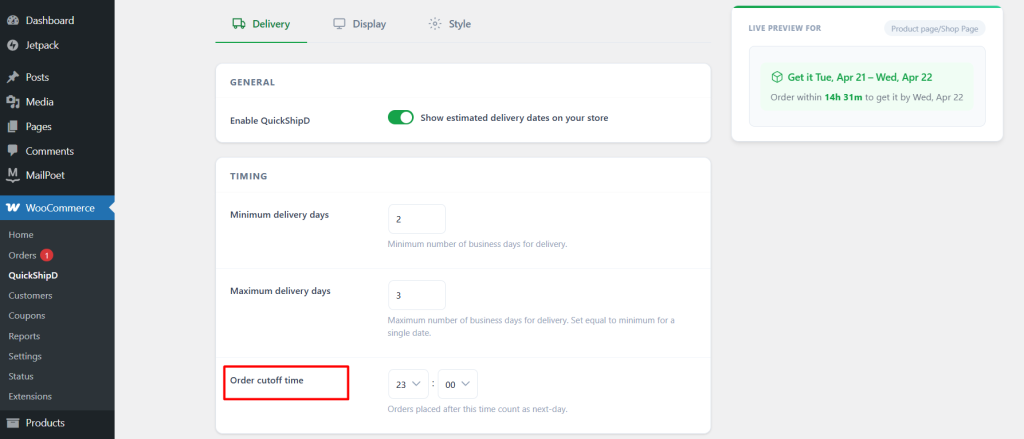
The dispatch date — sometimes called the ship date, the date of dispatch, or the shipment date — is the day your warehouse actually hands the package to the carrier. This is entirely within your control, and it’s driven by your processing time and order cutoff time.
If an order is placed after your daily cutoff, the dispatch date pushes to your next working day. This is the number most stores get wrong when they promise “ship in 24 hours” without a clear cutoff — an order placed at 11pm often can’t reasonably dispatch by the next morning.
Two things the dispatch date is not: it is not the day the customer’s payment cleared, and it is not the day you printed the label. A parcel sitting on your packing bench with a label on it has not been dispatched. The carrier taking possession is the event that matters, because that is the moment transit time starts counting.
Shipping Date: The Confusing Middle Term
“Shipping date” gets used two different ways depending on who’s talking, which is exactly why it causes confusion. Sometimes it means the same thing as dispatch date. Other times it’s used loosely to mean the entire shipping period — as in “shipping takes 3-5 days,” which is really describing transit time, not a single date.
The honest answer: this term is genuinely ambiguous in everyday use. If you’re writing customer-facing copy, avoid “shipping date” on its own and use “dispatch date” or “transit time” instead, so there’s no room for the reader to guess which one you mean.
| 🎯 NOTE If you take one thing from this article, take this: “shipping date” is the term most likely to be misread. Be specific about which date you mean, especially in emails and order confirmations. |
Delivery Date: What the Customer Actually Cares About
The delivery date is the one number customers actually care about: when the package physically arrives at their door. It’s the sum of your processing time, plus dispatch, plus carrier transit time, minus any non-delivery days in between.
This is also the number most stores fail to calculate correctly. It requires combining several variables, not just carrier transit time on its own.
A plugin like QuickShipD handles this by combining your delivery days, cutoff time, and non-delivery days into one accurate window. That’s different from just showing carrier transit time and calling it “delivery.”

| ✅ KEY TAKEAWAY Dispatch date is about you. Delivery date is about the customer. If your product page only shows one of these, make sure it’s the delivery date — that’s the number shoppers are actually trying to plan around. |
Is the Shipping Date the Same as the Delivery Date?
No — and this is the single most common mix-up in ecommerce. They are separated by the carrier’s transit time, which is almost never zero.
The confusion is understandable, because the two get collapsed constantly in everyday language. A store writes “ships in 2 days” and a customer reads “arrives in 2 days.” Both people think they had the same conversation. Then the parcel turns up on day five and only one of them is surprised.
There is exactly one case where the two dates genuinely coincide: same-day local delivery, where you dispatch and deliver inside the same working day using your own driver.
In every other setup — a national carrier, a courier, anything crossing a border — there is a gap. Pretending otherwise is what generates “where is my order?” tickets.
What Does “Dispatched” Mean When You’re Tracking an Order?
If you are a shopper and your tracking page has just changed to “dispatched,” it means the store has finished its part. The parcel has physically left the seller and is now with the carrier. Nothing more is waiting on the store.
What it does not mean is that delivery is imminent. Dispatched is the starting gun for transit, not the finish line. From that moment the clock the customer cares about is the carrier’s transit time, which is why a status of “dispatched” on a Friday afternoon frequently means a Tuesday arrival rather than a Saturday one.
Store owners: this is a useful thing to say out loud in your dispatch email. “Your order has been dispatched and is expected to arrive by Thursday 14 May” prevents far more support tickets than “Your order has been dispatched” on its own, because it answers the question the customer is about to ask anyway.
How Big Is the Gap Between Dispatch and Delivery?
It varies by service, and knowing the rough shape of it is what lets you set an estimate you can actually hit. These are typical ranges rather than guarantees — check them against your own carrier’s published transit times and, better still, against your own order history.
| Service | Typical gap from dispatch to delivery |
|---|---|
| Local delivery (own driver) | Same day |
| Express / priority courier | 1–2 business days |
| Standard domestic | 3–5 business days |
| Economy / free shipping tier | 5–7 business days |
| International standard | 7–21 business days, plus customs |
Note that every figure in that table starts after dispatch. Your own processing time sits in front of all of it. A store with a two-day processing time on a 3–5 day standard service is quoting a customer five to seven days, not three to five — and that arithmetic is where most inaccurate estimates come from.
Which Term Should You Use on Your Store?
A simple rule that holds up almost everywhere: use the delivery date when you are asking for the sale, and the dispatch date when you are reporting progress.
- Product page: delivery date. The shopper is deciding whether to buy, and the only question they are asking is when they will have the thing.
- Cart and checkout: delivery date. Repeat it rather than dropping it — shipping uncertainty at checkout is a well-known abandonment trigger.
- Order confirmation email: delivery date, expressed as a window. This is the message customers screenshot and refer back to.
- Dispatch notification: both. Confirm the dispatch happened, then restate the expected delivery window.
- Shipping policy page: both, defined explicitly. This is the one place where spelling out “processing time plus transit time” in full is worth the words.
- Anywhere at all: avoid “shipping date” unqualified. If you must use it, say which of the two you mean in the same sentence.
Quick Glossary of Every Date Term You’ll See
Carriers, marketplaces and plugins all use slightly different vocabulary for the same handful of ideas. This is the whole set:
- Processing time (or lead time): how long you take to get an order packed and ready. Yours entirely.
- Cutoff time: the daily deadline after which an order rolls to the next working day.
- Dispatch date / ship date / date of dispatch / shipment date: all the same thing — the day the carrier takes the parcel.
- Transit time: the carrier’s portion only, from dispatch to arrival. Excludes your processing time.
- Delivery date: the day it lands at the address.
- Estimated delivery date (EDD) / ETA: the calculated delivery date shown before it happens, normally as a range.
- Guaranteed delivery date: a formal commitment, usually a carrier product with a refund attached. Not the same as an estimate, and worth never conflating.
- Non-delivery days: weekends, public holidays and your own closures, which stretch every window that crosses them.
Use the Right Word for the Right Number
Dispatch date, shipping date, and delivery date describe three different points in the same journey. Only one of them — delivery date — is what your customers are actually trying to plan around.
Getting the terminology right in your own head makes it much easier to get the calculation right on your store.
QuickShipD calculates the full delivery date automatically, combining processing time, cutoff, and transit into one accurate window.
Frequently asked questions
What does dispatch date mean?
The dispatch date is the day your order physically leaves the seller and is handed to the carrier. It is set by the store’s processing time and daily cutoff, not by the carrier. It marks the start of transit, not the arrival.
Is the shipping date the same as the delivery date?
No. They are separated by the carrier’s transit time, which is typically one to seven business days domestically and considerably longer internationally. The only common exception is same-day local delivery, where both fall on the same day.
What is the difference between shipment date and delivery date?
Shipment date is another name for dispatch date — the day the parcel goes out. Delivery date is the day it arrives. Shipment date is controlled by the store; delivery date is controlled by the carrier once the parcel is in its network.
What does “expected dispatch date” mean on an order?
It is the store’s forecast of when it will hand your order to the carrier, usually shown for pre-orders, made-to-order items or anything temporarily out of stock. Add the carrier’s transit time on top of it to estimate arrival.
Which date should I show on my product page?
The delivery date. It’s the number that actually answers the question a shopper is asking, which is “when will I have this?” rather than “when will you send it?”
Why does my dispatch date sometimes push to the next day?
Because your order cutoff time has passed for the day. Orders placed after cutoff are treated as if placed at the start of the next working day.
Is transit time the same as delivery date?
No. Transit time is only the carrier’s portion of the journey, after dispatch. Delivery date accounts for processing time and dispatch first, then adds transit time on top.
Related Reading
- What Is an Estimated Delivery Date? (A Plain-English Guide)
- How to Add Delivery/Shipping Date in WooCommerce (2026 Guide)
- What's the Difference Between Processing Time and Shipping Time?
- Can I Automate Delivery Date Calculations in WooCommerce?
- How to Set a Different Delivery Time Per Product in WooCommerce (Step-by-Step)
- Delivery Estimates for Orders Mixing Digital and Physical Products
- Delivery Estimates for Custom or Made-to-Order Products
- Showing a Delivery Date Range Instead of a Single Date
- Estimated Delivery Date Per Product: Free Alternatives Compared
- Delivery Estimate Color Choices: What Builds Trust vs. What Hurts Readability