
Shipping from two warehouses instead of one sounds like it should make delivery faster — and it can, but only if your delivery estimate actually reflects which warehouse is fulfilling a given order. A single global estimate that ignores warehouse location either shortchanges your fast warehouse’s advantage or overstates your slow one’s speed.
Here’s how to think about delivery windows once more than one location is involved.
Why One Estimate Rarely Fits Every Warehouse
Different warehouses usually mean different transit times to at least some customers, and sometimes different processing capabilities too — a smaller regional warehouse might have a later cutoff time than your main facility, or handle a narrower product range.
If a customer near your West Coast warehouse and a customer near your East Coast warehouse both see the same national-average estimate, one of them is getting an estimate that’s needlessly conservative, and the other might be getting one that’s too optimistic.
| 🎯 NOTE The impact of this depends heavily on how different your warehouses’ coverage areas actually are. If both warehouses reach most customers in roughly the same timeframe, a single estimate is a reasonable simplification. |
The Practical Options for Multi-Warehouse Stores
If most products ship from a single primary warehouse and only a subset ship from a secondary one, per-product delivery day overrides are the simplest fix — set your global estimate around your primary warehouse and override specific products that ship from elsewhere.
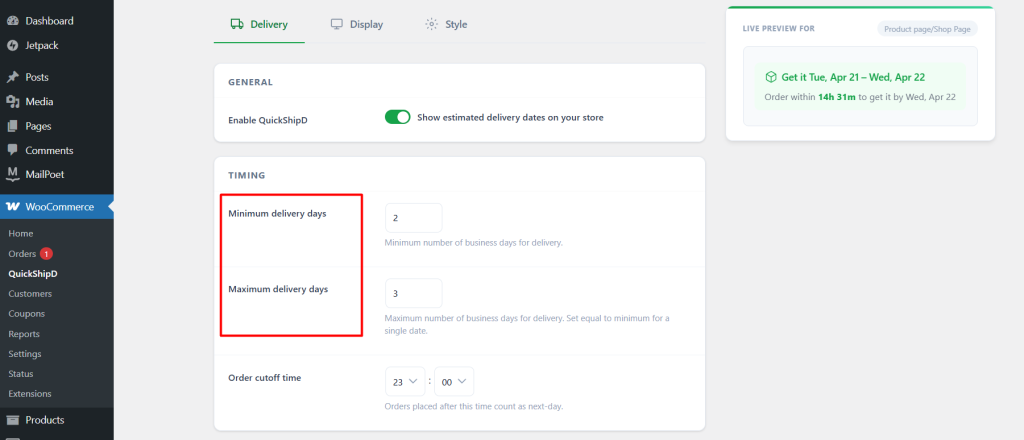
If your warehouses each carry overlapping inventory and orders route dynamically based on customer location or stock availability, a single, honest, slightly conservative store-wide estimate covering your slowest realistic warehouse-to-customer combination is the more practical approach, since a delivery estimate plugin generally can’t detect which warehouse will fulfil a specific order in advance.
| 🚧 IMPORTANT Don’t set your global estimate based on your fastest warehouse if orders can also route through a slower one. That guarantees the estimate will be wrong for a portion of your orders, in the direction that damages trust. |
When It’s Worth More Advanced Logic
Stores with genuinely complex multi-warehouse routing — where the estimate really needs to change dynamically per customer location — may need a more advanced logistics or inventory management solution alongside a basic delivery estimate plugin. This is a real limitation worth being upfront about: QuickShipD calculates from your configured settings, not live warehouse routing logic.
Match the Estimate to How Orders Actually Route
Multi-warehouse fulfilment doesn’t require a complex delivery estimate setup in most cases — it requires an honest look at how predictable your routing actually is, and a choice between per-product overrides and a conservative single estimate based on that.
QuickShipD supports either approach through its global and per-product settings.