
Offering both same-day and next-day delivery sounds like giving customers more choice, but it only works if each option actually feels different from the other. If your “same-day” and “next-day” estimates end up looking nearly identical on the page, customers won’t understand why one costs more — and won’t pay for it.
Here’s what customers are actually expecting from each option, what each one really commits you to, and how to make sure your store’s estimates reflect the real difference.
What Does Next-Day Delivery Actually Mean?
Next-day delivery means the order arrives on the next working day after it is dispatched — not the next day after it is ordered. That one word, dispatched, is where almost all the confusion lives. If you have a 2pm cutoff and someone orders at 4pm on Tuesday, the parcel leaves Wednesday and arrives Thursday. Two days after they bought it, and the promise was still kept.
Two more things it almost never means. It rarely includes weekends, so a Friday order commonly arrives Monday or Tuesday. And it is not a guaranteed time of day — “next-day” gets you a date, not a slot, unless you have paid for a timed service.
| 🎯 NOTE If you advertise next-day delivery, publish the cutoff time next to it. “Next-day delivery — order by 2pm” is a promise you can keep. “Next-day delivery” on its own is a promise the customer will define for you, and they will define it as tomorrow. |
Same-Day vs Next-Day: The Practical Differences
The gap between these two options is much wider operationally than it looks on a checkout page. This is what actually separates them:
| Same-day delivery | Next-day delivery | |
|---|---|---|
| Arrives | The day the order is placed | The working day after dispatch |
| Typical cutoff | Early — often 10am to midday | Later — commonly 2pm to 6pm |
| Who can offer it | Local delivery with your own driver, or a courier in one metro area | Any store with a national carrier’s express service |
| Relative cost to you | Highest — dedicated courier, no consolidation | Moderate — a standard carrier upgrade |
| Geographic reach | Usually one city or radius | Usually nationwide, minus remote areas |
| Usual failure mode | Missed cutoff by minutes; no second chance that day | Weekend or holiday quietly absorbs a day |
The practical read: next-day is a shipping option you can buy, while same-day is an operation you have to run. That is why most stores should get next-day right before they consider offering same-day at all.
What “Same-Day” Actually Needs to Mean
Customers who choose same-day delivery expect exactly that — not “usually same-day” or “same-day if ordered early enough” without being told what “early enough” means. If your same-day option depends on a cutoff time, that cutoff needs to be visible and specific, not a hidden condition discovered after the fact.
This is also the option with the least tolerance for a missed promise. A customer who paid extra for same-day and didn’t get it is far more frustrated than one who paid standard rates and experienced the same delay.
| 🪧 IMPORTANT Only offer same-day delivery if your operation can consistently hit it. The reputational cost of missing a same-day promise is disproportionately higher than missing a standard one — the customer paid a premium and expects a premium result. |
What “Next-Day” Needs to Mean on Your Store
Next-day delivery gives you slightly more room, but customers still expect it to mean the following calendar day — not “within 24 business hours” if that phrase quietly stretches across a weekend. If your next-day option doesn’t run on weekends, say so clearly rather than letting the customer discover it when their Friday order arrives Monday.
The cheapest fix here is wording, not logistics. “Order by 2pm Mon–Thu for next-day delivery. Friday orders arrive Monday.” costs you nothing and removes the single most common complaint about next-day services.
Making the Difference Visible on Your Product Page
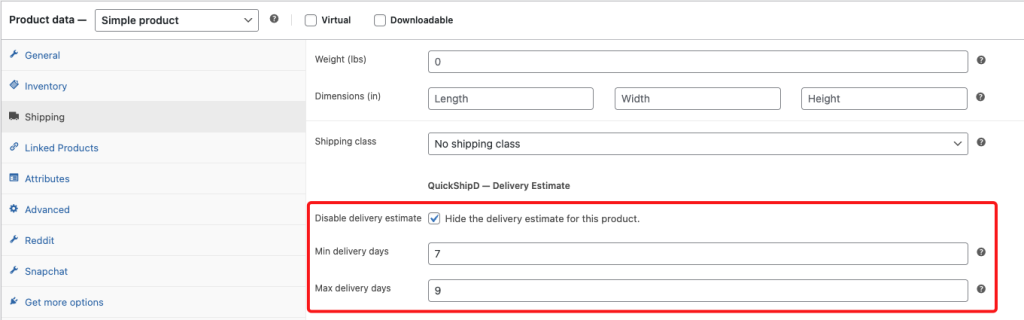
If you offer both options on the same product, the estimate for each needs to look meaningfully different — not just in the number, but in how confidently it’s stated. Per-product delivery day overrides in QuickShipD let you show a tighter window for express-eligible items, so the premium option visibly earns its price difference.
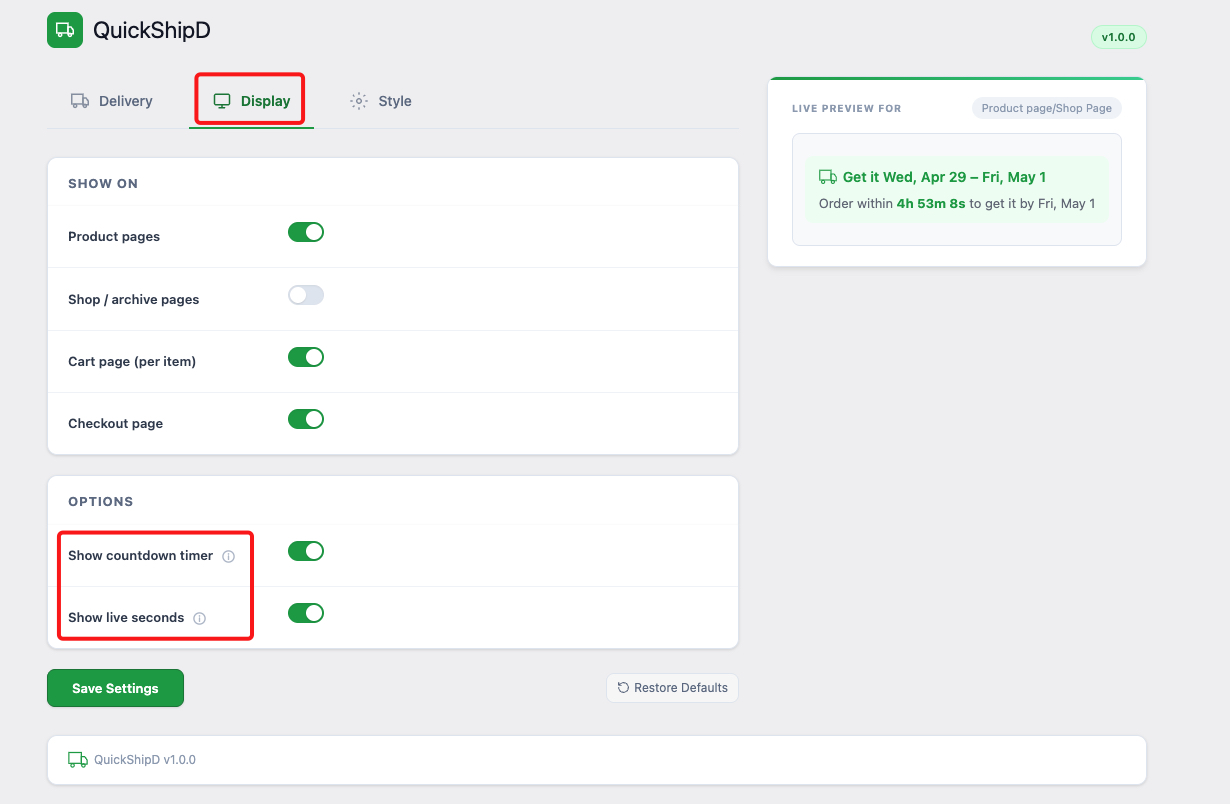
A live countdown to the cutoff does more work here than any wording change. “Order within 3h 12m for next-day delivery” converts the abstract promise into a decision the shopper can act on now, and it is the one element that makes a premium option feel urgent rather than optional.
| 💡 PRO TIP Pair your delivery estimate with clearly named shipping methods at checkout — “Standard (3-5 days)” next to “Express (Next Day)” — so the choice and its consequence are obvious in the same glance. |
Make the Promise Match the Price
Same-day and next-day delivery only work as separate options if customers can see — and trust — the difference between them. Clear cutoffs, honest limitations, and visibly different estimates are what make a premium shipping option worth paying for.
QuickShipD’s per-product overrides and cutoff countdown make that visible difference easy to set up without extra tools.
Frequently asked questions
What does next-day delivery mean?
It means the order arrives on the next working day after dispatch, not the next day after purchase. If the order misses that day’s cutoff, dispatch moves to the following working day and arrival moves with it. Weekends are usually excluded.
Is next-day delivery actually the next day?
Often, but not always. It is the next day only when the order clears the cutoff and the following day is a working day. Order after cutoff, or on a Friday, and the real arrival is two or three days out — which is why publishing the cutoff matters more than the phrase itself.
What is the difference between same-day and next-day shipping?
Same-day arrives on the day of purchase and needs an early cutoff plus local delivery capability. Next-day arrives the following working day and can be bought as a carrier upgrade. Same-day is an operation you run; next-day is a service you buy.
Does same-day delivery cost more than next-day?
Almost always, and usually by a wide margin. Same-day means a dedicated trip with no chance to consolidate the parcel with other orders, so the delivery cost sits with a single order rather than being spread across a route.
Should I offer same-day delivery if I’m not sure I can meet it consistently?
No. It’s better to offer a next-day option you can reliably meet than a same-day one you’ll frequently miss. Reliability matters more than speed on paper.
Do I need different plugins for same-day vs next-day estimates?
No. A single delivery date plugin with per-product overrides, like QuickShipD, can show different windows for different products without needing separate tools.
What’s the biggest mistake stores make with express options?
Showing the same delivery estimate for both standard and express shipping. If the estimate doesn’t change, the customer has no reason to pay for the faster option.